
What Is This Gopher Doing in My Lawn and Where Did It Come From?
Identification
If a gopher suddenly appears in your lawn, it may not have started there. Gophers tunnel underground and travel from neighboring properties into lawns, gardens, and other areas where they find food.
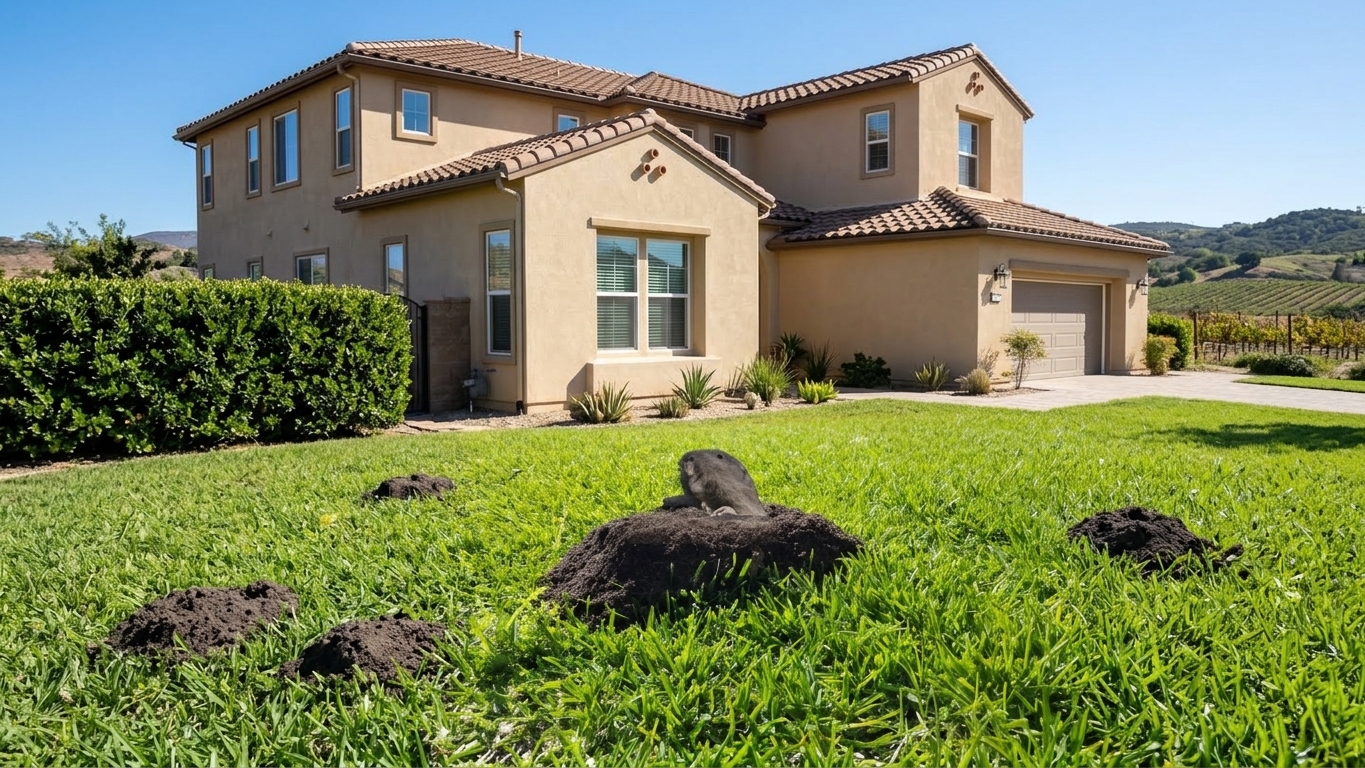
In this Temecula, California case, the gopher had traveled from a neighboring property, stayed hidden behind bushes, and moved into the homeowner's front lawn to feed on fresh grass. Once we identified that the gopher was commuting into the lawn, traps were placed and the gopher was caught on its next trip in.
Watch the video
This video shows how observing the gopher's movement revealed that it was traveling from a neighboring property into a Temecula front lawn to feed.
Where did the gopher in my lawn come from?
A gopher in your lawn may have come from a neighboring property, especially when suitable food or landscape conditions are available there.
Gophers spend most of their lives underground in burrow systems and are not commonly seen above ground. Their tunnels allow them to move through the landscape without following property boundaries.
That means a gopher can appear to be a sudden new problem even though it may have been living or traveling nearby for some time.
Can a gopher come from my neighbor's yard?
Yes. A gopher can move from a neighboring yard into your property if its underground tunnel system or feeding activity reaches your landscape.
Gophers do not recognize property boundaries. A fence may mark the property line for people, but it does not stop an animal that lives and travels underground.
In the Temecula lawn shown in this video, the gopher was traced back toward the neighboring property. Bushes provided cover near the property line, while the homeowner's fresh lawn provided an attractive food source.
Why did a gopher suddenly appear in my lawn?
A gopher may appear suddenly because the animal was already nearby and has found a reason to enter your yard.
Lawns, gardens, and irrigated landscapes can provide favorable feeding conditions because gophers eat plant roots and other plant material.
Gophers can move into your yard because:
- Your yard has better food and water
- Your yard is a good, safe place to live
- Neighboring new landscaping or construction (like a pool) has driven them out and they need a new place to live
The gopher did not necessarily "come out of nowhere." It may simply have become noticeable when its activity reached an area you regularly see.
Why would a gopher come into my lawn?
A gopher may enter a lawn because it provides accessible food and favorable soil conditions.
Gophers primarily feed on plant roots and other plant material. They can damage lawns, gardens, landscape plants, and irrigation systems while digging and feeding.
A healthy, irrigated lawn can therefore become an attractive feeding area even if the gopher's main tunnel system is somewhere else.
In the Temecula example, the gopher was using the neighboring landscape as its route and moving into the homeowner's lawn to feed on the fresh grass.
If you are dealing with an active gopher problem, see our gopher control page for more information about identifying and controlling gopher activity.
How do gophers get from one yard to another?
Gophers can move between yards through underground tunnels and by digging new sections of their burrow system.
A gopher's underground system consists of a main runway with lateral tunnels branching toward feeding and mound areas. The animal spends most of its time underground, which makes its movements difficult to see from the surface.
This is one reason a gopher problem can be confusing to homeowners. You may see damage in your yard without seeing where the animal is actually coming from.
Can a gopher travel a long distance?
Yes. Individual gophers can maintain extensive underground tunnel systems, although the distance varies with soil, food availability, habitat, and other conditions.
This does not mean every gopher travels hundreds of feet between yards. It means that the visible mound or damaged patch of lawn may not tell you the entire story of where the animal is operating.
Why don't I see the gopher?
You usually don't see a gopher because it spends almost all of its time underground.
Gophers are secretive, underground rodents. Their presence is more commonly identified by fresh mounds, damaged plants, disappearing vegetation, or other signs of digging than by actually seeing the animal.
That makes a visible gopher in a lawn especially useful information. If you actually see one, it can provide an opportunity to observe where it is entering, where it is feeding, and how it is moving through the landscape.
What are the signs that a gopher is active in my lawn?
The most common sign is fresh gopher dirt or a newly formed mound.
Typical gopher signs include:
- Fresh crescent- or fan-shaped dirt mounds
- Old, open gopher holes suddenly filled with fresh dirt
- Ornamental grasses being eaten next to gopher mounds
- Plants dying with mounds around their base
- Plants disappearing or being pulled underground
- Soil being pushed up through the lawn
Correctly identifying an active gopher is the first step in deciding how to deal with it.
How can I tell a gopher mound from a mole mound?
Gopher mounds are generally crescent- or horseshoe-shaped with the tunnel opening or soil plug offset to one side. Mole mounds are typically more circular or volcano-shaped.
Gophers and moles are both underground animals, but they behave differently and leave different signs. Gophers primarily eat plant material and roots, while moles primarily feed on insects and other soil organisms.
If you are not sure which animal is causing the damage, a gopher exterminator can provide information about identifying and removing an active gopher problem.
If the gopher is coming from my neighbor's yard, will it eventually leave?
Usually not. Because of the territorial nature of gophers, once they have establish a tunnel system in a yard, they rarely just leave on their own.
If your lawn continues to provide food and suitable conditions, the area can remain attractive to the gopher.
If fresh mounds or damage continue to appear, the important question is not simply where the gopher was yesterday. The important question is where the active gopher is operating now and how it is getting into the area being damaged.
Does a fence stop gophers?
A normal yard fence does not stop a gopher from moving between properties because gophers travel underground.
A fence can stop or redirect animals that travel above ground, but a gopher can pass underneath a typical property-line fence through its underground tunnel system.
For an existing gopher in an established lawn, identifying and removing the active animal is often more practical than trying to determine which side of the property line it originally came from.
Should I treat my whole yard for one gopher?
Not necessarily. The location of the active gopher and its tunnel system should be identified before deciding how much of the property needs attention.
A gopher problem is not always a "whole yard" problem. Sometimes the activity is concentrated in one section of the landscape, while the animal is entering from an adjacent property or another nearby area.
The Temecula example demonstrates why looking beyond the visible damage can be important. The gopher was not simply sitting in the middle of the homeowner's lawn. It was using the neighboring landscape and moving into the lawn to feed.
How do you find where a gopher is coming from?
Finding the source of gopher activity starts with following the evidence rather than assuming the mound tells the whole story.
What to look for:
- The oldest mounds are the beginning of the tunnel system
- The freshest mounds are the at the end of the tunnels
- Trace back from newest to oldest and that will lead you to the source
In the Temecula video, observing the gopher's movement helped reveal that it was traveling from the neighboring property into the lawn.
How was the gopher in this Temecula lawn removed?
Once the gopher's activity pattern was identified, traps were placed in the active area and the gopher was caught on its next trip into the lawn.
This is an example of why identifying the animal's behavior and location can matter as much as identifying the damage.
Rather than treating the entire property blindly, the goal was to determine where the gopher was actively traveling and feeding and place traps accordingly.
For more information about the trapping approach, see gopher trapping.
What is the difference between gopher trapping and gopher control?
Gopher trapping is a specific removal method, while gopher control is the broader process of identifying, removing, and addressing active gopher problems.
Trapping targets the gopher inside its active tunnel system. Gopher control can involve inspecting the property, locating active areas, determining how the gopher is using the landscape, and removing the animal.
For a broader explanation of the process, see gopher control.
What is a gopher killer?
A gopher killer is a professional who specializes in locating and removing gophers, typically by placing traps in their active underground tunnel systems.
Gopher Stop uses a poison-free trapping approach rather than relying on poison bait.
Learn more about the process on the gopher killer page.
Can gophers come back after they are removed?
Yes. Removing one gopher does not permanently prevent another gopher from entering the property later.
Residential landscapes can remain attractive to gophers because they provide food and favorable digging conditions. A neighboring property can also remain a potential source of future activity.
That is why it is useful to distinguish between removing the current gopher and preventing every future gopher from ever entering the property. Those are two different problems.
What should I do if a gopher suddenly appears in my lawn?
First make sure you actually have a gopher. Brand new fresh crescent-shaped mounds appearing is the sign you are looking for.
Next try to identify the source of the gopher:
- Neighbor's yard
- Open field, hills or a park near by
- New construction or landscaping
Then act quickly:
- Set traps yourself or hire a local pro as soon as possible
- Ensure all the gophers have been removed
- Use a castor oil based repellent to potentially keep new gophers from coming back
- Keep a vigilant eye on your yard and act quickly to set traps if any new gophers show up
If you actually see the gopher, pay attention to where it came from and where it goes. A visible gopher can provide valuable information about how it is using the landscape.
Do not assume that the gopher's point of entry is the same as its home area.
Gopher Control in the Temecula Valley
Gophers can move into Temecula neighborhoods from surrounding parks, natural areas, and neighboring properties. Gopher Stop provides poison-free Gopher Control in the Temecula Valley.
Most neighborhoods in the Temecula Valley are surrounded by beautiful wilderness. We get a lot of critters coming onto our properties from the wild:
- Snakes
- Coyotes
- Raccoons
- Possums
- Squirrels
- AND Gophers
Gophers are just part of the natural wildlife in Southern California that we sometimes have to deal with in our yards.
Key takeaway: the gopher may not belong to "your" yard
A gopher in your lawn does not necessarily mean the gopher lives in your lawn.
Gophers travel underground, can move between neighboring properties, and may enter a lawn because it provides attractive food and landscape conditions.
In the Temecula example, the gopher was traveling from the neighboring property, staying hidden behind bushes, and entering the homeowner's lawn to feed on fresh grass.
Once that behavior was identified, the active gopher could be targeted rather than simply treating the visible lawn damage.
Gopher Stop's approach
Gopher Stop removes gophers throughout Southern California using a poison-free trapping system.
The focus is on identifying where the gopher is active, understanding how it is using the property, and placing traps in the active tunnel system. The goal is to remove the gopher causing the current problem rather than relying on a blanket treatment approach.
For homeowners dealing with a gopher that seems to have suddenly appeared, one of the first questions to answer is simple:
Where is the gopher actually coming from?
Sometimes the answer is next door.